Mobility · Travel without flying
International Night Trains in Europe
Leave in the evening, sleep on the way, arrive at the heart of another capital by morning. After two decades of decline, the night train is being reborn in Europe — driven by ÖBB Nightjet and a new generation of operators.
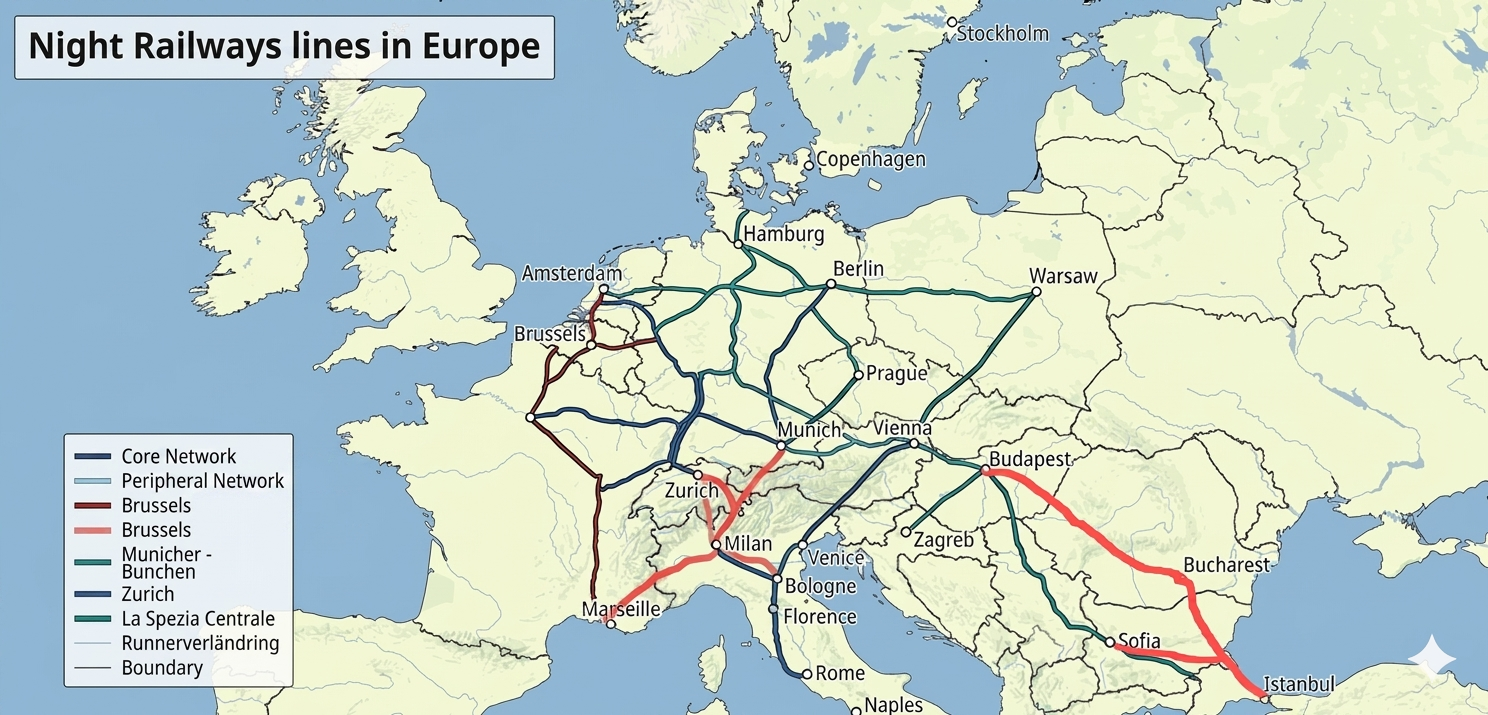
A network in full revival
The night train almost disappeared from Europe. Undercut by low-cost airlines, daytime high-speed rail and ageing rolling stock, it was massively cancelled in the 2000s and 2010s. Deutsche Bahn even abandoned all of its night trains at the end of 2016.
Since then, the tide has turned. Led by Austrian operator ÖBB and its Nightjet brand, new routes open every year, private and cooperative operators are emerging, and several historic discontinued services have been relaunched. Travelling far without flying is once again possible — and comfortable. In France too, the national network of Intercités de Nuit is being revived, with eight routes from Paris and a recovery plan targeting 2030.
ÖBB Nightjet
Operated by the Austrian federal railways, Nightjet is the largest night train network on the continent: it connects 13 countries with private cabins, couchettes and seats. From Vienna, Munich and Zurich, it serves Paris, Amsterdam, Brussels, Berlin, Hamburg, Rome, Venice, Milan and beyond — including the direct Munich–Florence–Rome route (NJ 295).
The network today
The core of the network is organised around three major Alpine hubs — Zurich, Munich and Vienna — from which routes radiate westward (Paris, Brussels, Amsterdam), northward (Berlin, Hamburg), southward (Rome, Venice, Milan) and eastward (Budapest, Zagreb).
Beyond this core, a peripheral network extends travel to the fringes of the continent: the Carpathians and Transylvania toward Bucharest, the Balkans toward Sofia and Belgrade, the Bosphorus with the legendary service to Istanbul, and the Scandinavian far north up to the Arctic Circle.
The operators
The European night train is not the monopoly of a single company: it is a mosaic of national, private and cooperative operators.
Discontinued routes — and those being revived
Today's map is also a map of absences. Many iconic night train services were axed over the years, victims of low-cost aviation, budget cuts and ageing rolling stock. Some have since been relaunched.
- City Night Line (Deutsche Bahn) — the entire German night train brand shut down in December 2016. ÖBB took over part of the network to launch Nightjet. → Network largely taken over by Nightjet.
- Thello — Paris ↔ Venice — the last trans-Alpine night train from France, stopped in 2020. → Paris–Italy night service resumed by Nightjet (Paris–Rome/Milan).
- Elipsos "Trenhotel" — Paris ↔ Madrid & Paris ↔ Barcelona — discontinued end of 2013 with the arrival of high-speed rail. → No direct night replacement yet (connection via Hendaye).
- Paris ↔ Berlin / Hamburg / Munich (City Night Line) — discontinued around 2014. → Paris–Berlin night relaunched end of 2023 (Nightjet); Paris–Berlin/Hamburg axis also served by European Sleeper.
- Lunéa / Corail Lunéa (SNCF) — almost all domestic French night trains cancelled between 2014 and 2017; only two remained. → Revival of Intercités de Nuit: Paris–Nice returned (2021), new services (Aurillac, Tarbes/Hendaye).
- EuroNight Paris ↔ Moscow and other long-haul east–west services — discontinued during the 2010s.
The contrast is stark: where lines were being closed in the early 2010s, they are being reopened today. Paris–Vienna (2021), Paris–Berlin (2023), Brussels–Prague then Brussels–Milan (European Sleeper), Paris–Rome (2024)… the network is rebuilding itself year by year.
Why choose the night train
On the same route, a plane emits up to 50 times more CO₂ than a train. The night train adds a decisive advantage: it replaces both the flight and the hotel night. You leave a city centre, sleep, arrive in another city centre rested — no airport, no shuttle, no jet lag.