Mobility · Travel without flying
Domestic Night Trains in France
Leave Paris in the evening, sleep on the way, arrive at the foot of the Pyrenees, the Alps or the French Riviera by morning. Having nearly disappeared, the Intercités de Nuit operated by SNCF are being reborn — and a revival plan aims for around ten routes by 2030.
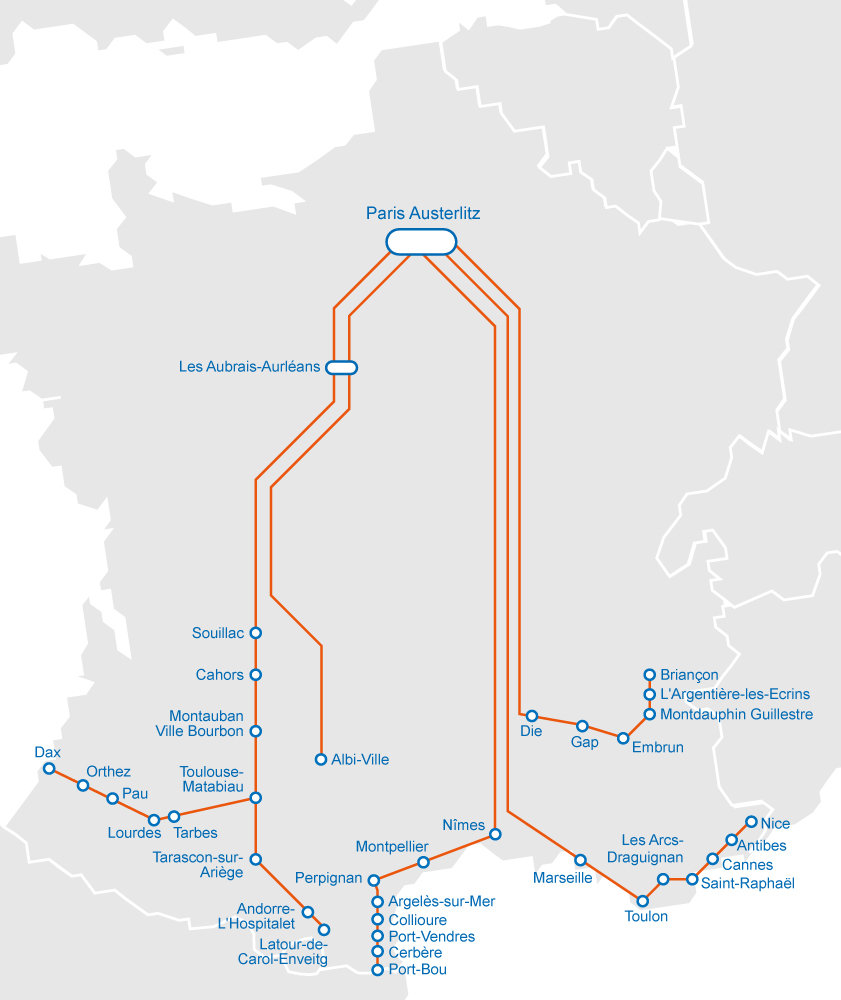
A network coming back to life
France once had one of the most extensive night train networks in Europe. Between 2014 and 2017, almost all domestic routes (the former Corail Lunéa) were cancelled, squeezed out by daytime TGV and low-cost aviation: only two remained.
Since then, the government and SNCF have reversed course. Paris–Nice was relaunched in 2021, Paris–Aurillac in 2023, Paris–Rodez / Albi in 2024. All routes now depart from Paris Austerlitz and are operated by SNCF under the Intercités de Nuit brand. For cross-border services, see also our page on international night trains in Europe.
SNCF — Intercités de Nuit
The sole operator of domestic night trains in France, SNCF offers seats and couchettes (4- or 6-berth compartments) on eight routes from Paris. Book on SNCF Connect — as soon as sales open to get the lowest fares.
The 8 Intercités de Nuit routes
A selection of regular services, with their main stops, frequency, approximate journey time and an indicative starting price for a couchette (SNCF dynamic fares — cheaper when booked early).
| Route | Main stops | Frequency | Duration | From |
|---|---|---|---|---|
| Paris → Nice | Marseille, Toulon, Cannes, Antibes, Nice Ville | Daily | ~12 h 00 | €39 |
| Paris → Briançon | Crest, Die, Gap, Embrun, Briançon | Daily | ~11 h 40 | €29 |
| Paris → Cerbère | Nîmes, Montpellier, Narbonne, Perpignan, Cerbère | Seasonal / weekends | ~10 h 15 | €39 |
| Paris → Tarbes / Lourdes | Bayonne, Biarritz, Hendaye, Pau, Lourdes, Tarbes | Daily | ~9 h 50 | €39 |
| Paris → Latour-de-Carol | Auterive, Foix, Ax-les-Thermes, Latour-de-Carol-Enveitg | Daily | ~9 h 40 | €29 |
| Paris → Rodez / Albi | Figeac, Rocamadour, Rodez, Albi Ville | Daily | ~9 h 15 | €29 |
| Paris → Aurillac | Châteauroux, Limoges, Saint-Denis-près-Martel, Aurillac | Daily | ~8 h 15 | €29 |
| Paris → Toulouse | Les Aubrais, Cahors, Montauban, Toulouse Matabiau | Daily | ~7 h 30 | €29 |
Durations and frequencies are indicative (network updated 2026); some routes split en route (e.g. Tarbes / Hendaye). Always check schedules and availability on SNCF Connect before booking.
How much does it cost?
Intercités de Nuit use dynamic pricing, but remain among the cheapest ways to cross France:
- Seat (2nd class): from around €19 when booked early.
- Shared couchette (6-berth in 2nd class, 4-berth in 1st): from around €29, generally €29 to €69 depending on the route and date.
- Private compartment (by reserving all couchettes to travel with family or friends): possible on most routes.
- SNCF discount cards (Avantage, Liberté) and youth / child fares applicable.
For the same budget, the night train combines two expenses in one: it replaces both the ticket and the hotel night. You leave a city centre in the evening, arrive in another city centre in the morning, rested — no airport, no shuttle.
Night train vs. plane: the CO₂ comparison
This is the decisive argument. Intercités de Nuit run on electrified lines powered by the French electricity mix, which is very low-carbon. The result: on the same route, the train emits around 20 to 30 times less CO₂ than a domestic flight.
| Route | Plane (per passenger) | Night train | Saving |
|---|---|---|---|
| Paris → Nice | ≈ 160 kg CO₂ | ≈ 7 kg CO₂ | ≈ 23× less |
| Paris → Tarbes / Lourdes | ≈ 160 kg CO₂ | ≈ 5 kg CO₂ | ≈ 30× less |
| Paris → Perpignan / Cerbère | ≈ 170 kg CO₂ | ≈ 5 kg CO₂ | ≈ 30× less |
| Paris → Toulouse | ≈ 135 kg CO₂ | ≈ 4 kg CO₂ | ≈ 30× less |
| Paris → Briançon | ≈ 150 kg CO₂ (via Marseille, no direct flight) | ≈ 4 kg CO₂ | ≈ 30× less |
Approximate figures based on ADEME emission factors: domestic flight ≈ 230 g CO₂e per passenger-km (including non-CO₂ effects), long-distance electric train ≈ 6 g. Add to this, for the plane, the journey to and from the airport.
Planned routes by 2030
The government and SNCF are pursuing a night train revival plan targeting around ten routes, with an order for new rolling stock (aiming for around 300 coaches and sleeper cars). Beyond the current routes, the official map of planned services outlines a much larger network.
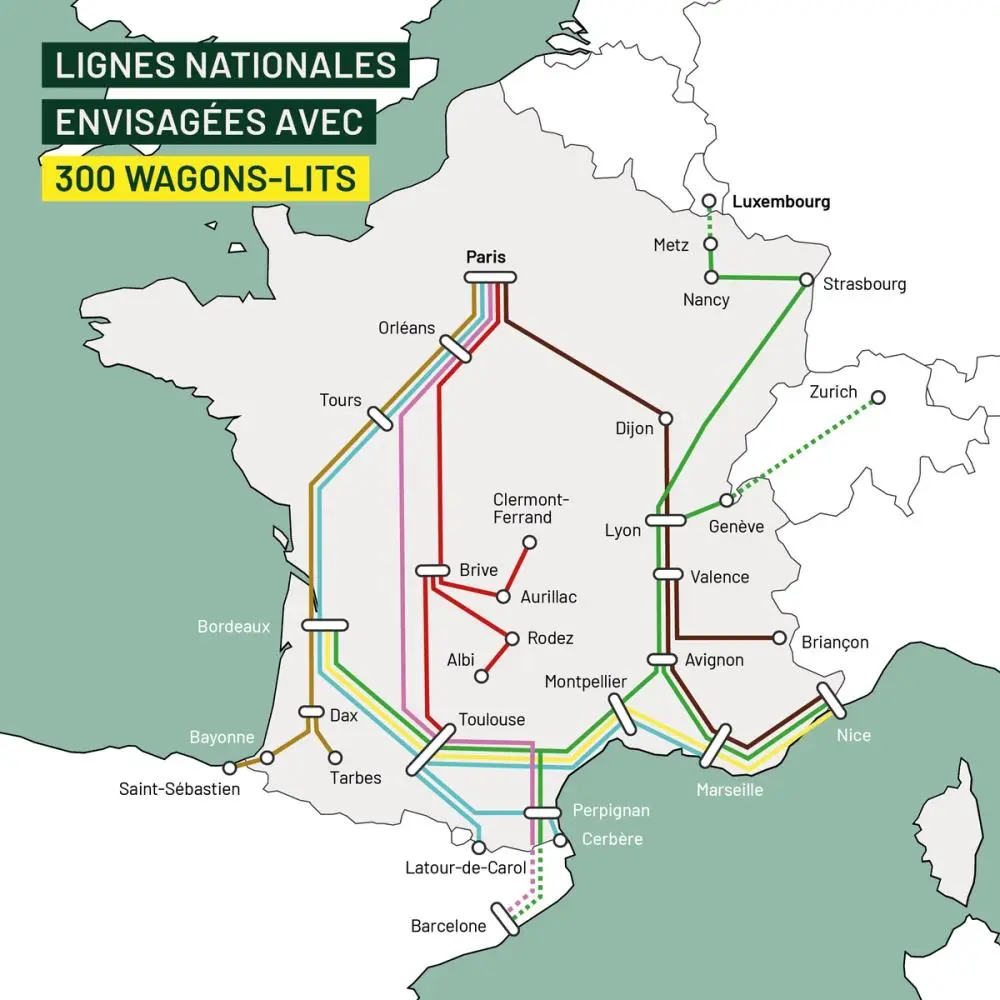
New radial routes from Paris
- Paris – Bordeaux – Bayonne / Dax / Tarbes, extending to the Basque Country (and beyond toward San Sebastián).
- Paris – Clermont-Ferrand, a new service to the heart of the Massif Central.
- Paris – Brive – Aurillac / Rodez / Albi, reinforcing Massif Central connections.
- Paris – Dijon – Lyon – Valence – Avignon – Briançon / Nice, toward the Alps and the Mediterranean.
Cross-country routes bypassing Paris
- Bordeaux – Toulouse – Montpellier – Marseille – Nice: the long-awaited great southern transversal.
- Strasbourg / Metz / Nancy – Lyon – Marseille – Nice: linking the East to the Mediterranean overnight.
- International extensions under study toward Geneva, Zurich and Barcelona (via Perpignan / Cerbère).
In parallel, private projects have sought to relaunch "hotel-style" night trains (Midnight Trains, Le Train, Railcoop); most have been suspended, leaving the national offering in the hands of SNCF and the state.